
I - Rich Gifts
Last month, when the Maduro plucking saga was going down, I remember being struck by how Tyler Cowen ended off a provocative piece of commentary:
Effective Altruists, are you paying attention?
He meant to suggest that, given the gigantic gains in Venezuelan asset values, intervention was seemingly working out to become a humanitarian miracle (from the standpoint of future expected wellbeing for Venezuelans).
It was the general structure of this point that stuck with me. The most effective interventions for improving lives might be drastic political actions, not mass well-targeted giving by individuals. So it could be the case that instead of hopping on GiveWell and donating to the Against Malaria Foundation,1 it would be more moral to donate to a political candidate who can tip the scales on an important policy.
Taking this seriously means we need to search for political moves that would massively improve human welfare. They should be unambiguous on this front, otherwise the normal EAs will justifiably point to the uncertainty involved and opt for the less risky plays they’re used to.
Fortunately, the motherlode of effective policies is sitting right there:
If we had worldwide free trade, it’s estimated global GDP might go up 5% (probably less).
If we had open borders, it’s estimated it would go up 50-150% — that ranges between adding $62 trillion and $185 trillion worth of new welfare to the world. Every year.2 Welfare that would accrue largely to the global poor, AKA the existing target recipients for Effective Altruism.

II - Unkind Givers
Let’s suppose away the political constraints right now. After all the math would be pretty clear in favour of policy-centric giving at this scale no matter how strong they are…
If what matters are life evaluations.
That is, if the point of giving is to make it so the most possible people look back at their lives and forward toward their future goals and feel quite good about both, all things considered. These evaluations straightforwardly improve as people get richer.3
But what if the point is to make the most people happy? Feeling good, swell, upbeat. Does enrichening achieve that?
Enter ‘Miserable Migrants?’, a 2015 paper by Steven Stillman and co that derives good causal estimates for the effects of moving to a Western, Educated, Industrialized, Rich, and Democratic country from a middle-income communal country.4
The migrants, coming from Tonga to New Zealand, experienced a tripling in wages, improved mental health, were more satisfied with their income and… reported themselves less happy than before they came. Substantially so.
On a five point scale, four years after migrating, the migrants were, on average, almost a full point less happy. It wasn’t an immediate effect. Instead, slowly but surely, life in New Zealand wore them down.
Or rather, they became New Zealanders. When you go digging, it turns out that the biggest determinant of average positive disposition is a country’s culture, not its wealth. Countries high in baseline happy feelings tend to:
Be high in sociality, warmth, and interpersonal expressiveness
Foster dense informal social networks with extended families
Treat positive emotions as a social obligation or virtue
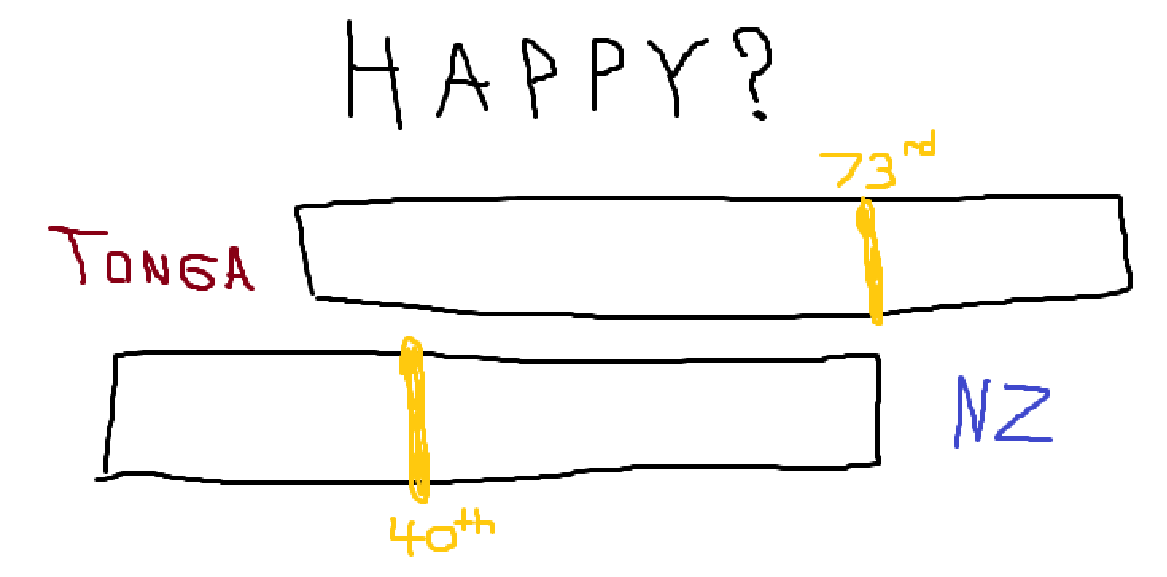
Money helps, but only to re-order individuals since the baseline is essentially zero-sum. That means that once the Tonga migrants got settled as lower-middle class (think 40th percentile) in New Zealand, they wind up less happy than when they were upper-middle class (73rd percentile) in Tonga, since New Zealand has a worse baseline than Tonga and their position relative to the baseline worsened.
III - Hedonism Waxes Poor
Since we’re in the Davos social engineering headspace, we might as well ask why we don’t just get open borders and make our culture more like Tonga’s. That way everyone gets in a good mood, the Tongans get rich, and nobody loses.
Well, it turns out all of those listed factors help put your country into the middle income trap. They’re anathema for growth; growth = satisfying more preferences; life evaluation turns on preference satisfaction; ergo, they’re anathema for life evaluations. The crux of this are the ways in which robust kinship networks keep people static. They tend to keep more women in the home, keep smart high-achievers in low efficiency communities, and promote distrust of outsiders, making it difficult to reap the benefits of complex cooperation.
That distrust of outsiders also makes it more difficult for migrants to integrate into society. It promotes a particularist morality that prizes treating one’s relatives better. Not just in the household is this expected, but in all spheres. So if New Zealand as a whole were to tip this way, we would expect it to become a lot harder for migrants to arrive and build a life there, softening the gains from opening the border.
When the listed factors don’t income trap you, they make you racist.
East Asia has a few examples of nations that are high-kinship high-growth, but all of them are famously distrustful of outsiders. Think Japan, South Korea, and China. Even if you manage economic success as a migrant, these places make it very difficult to socially integrate and build networks, withholding one of the key hedonic ingredients from outsiders.
So it seems, at least in this case, that you can’t serve both masters. Money only straightforwardly buys one sort of happiness, culture buys the other. It’s people’s preferences with respect to the course of their lives, in which case the GOAT policy is right there, or it’s their day-to-day happy feelings, in which case EAs should seize control of the culture or speedrun the experience machine. Open borders or hedonism and not both. Choose wisely.
Goes without saying you should do this (instead of donating to shrimp)
Killingsworth, Kahneman, and Mellers (2023) brings together Kahneman, who had previously found that past $75k money doesn’t make you happier, and Killingsworth, who found no limit, to settle their contradictory results. It turns out 1/5 people are, roughly speaking, constitutionally unhappy (or static?), and they gain no further happiness past $75k. The other 4/5 gain continuously.
Stillman et al. (2015) - New Zealand lotteries off migration slots to people in Tonga. Normally causal identification is hard, because migrants tend to be those who self-select to migrate. The lottery gets around this problem because the researchers can compare lottery winners to lottery losers and then divide the treatment effect by the difference in migration rates between the two groups to get an estimate of the effect of migration on migrants.