
On Tuesday I was in Stratford to see The Tempest. I don’t have other data to make a comparative claim — never seen professional Shakespeare before — but it was an excellent time. The town has an intentional architectural charm, its core lined with colourful, inviting cafes and brasseries, topped with brick apartments, flanked by greenery and many birds. It’s compact enough that a power outage took out everywhere to eat, but everyone seemed pleased enough to wait things out on the patios, listening to a steady thunder that never brought rain. Though a bit out of the way for a visitor to Ontario, it’s as good a rural rep for the province as any and worth making the trip to.

Now, The Tempest.
The play is the final one to have been solo-authored by Shakespeare and moves along as breezily as one would expect from a man with 35 plays’ worth of writing experience. Our chief players are Prospero, a crusty father and the former Duke of Milan who lost his seat to his brother Antonio after getting way too into magical theory and losing interest in the world; his daughter Miranda, a naive but endearingly open girl, exiled with him to a small, nameless island; his spirit slave Ariel, who owes him a life debt for being rescued by him; his quasi-human slave Caliban, who is serving a life sentence for attempting to rape Miranda;1 and the gang of miscreant nobles, headed by Alonso, King of Naples, and including Antonio, which shipwrecks ashore Prospero’s island in the opening scene by a tempest of his devising.
Prospero seizes on the opportunity of his enemies sailing nearby to split the king’s heir away from the group, easily matchmaking him with Miranda. Meanwhile, he directs Ariel to stir up enough trouble for the rest of the shipwreckees to keep them busy and himself entertained. Much of our time as an audience is spent watching him play God, and like Milton’s God, he even allows a rebellion to take shape, led by Caliban. King Alonso, ground into a forgiving disposition by magical spectacle, realizes the opportunity to solidify his political strength in Milan once informed of the marriage and joyously grants Prospero back his dukedom. Ariel is freed and Caliban’s fate left ambiguous as Prospero lays down his magic and resolves to return to the world of men, his scheme perfectly executed.
This summary should make sense of why Harold Bloom wrote ‘The Tempest was the first significant drama in which not much happens, beyond its protagonist’s abandonment of his scheme of justified revenge precisely when he has all his enemies in his power.’2
The use of magic dots the runtime with spectacle and the play is hilarious in performance, but it wants for tension and stakes. No one in the audience actually believes that Prospero is going to do something awful to his captives—they were too easily caught. As he tells us to justify his unnecessary meddling with Miranda’s courtship, ‘too light winning / Make[s] the prize light.’
So what keeps the play working? It’s that it’s unusually ripe for imposing our own readings upon it. Doing so, abandoning all pretense of going along with the literal intent of the author, lets us surface aspects of the author’s actual achievement. Aspects which are felt but resist description prior to recasting the play in our new light.
The most famous reading imposed upon The Tempest is the post-colonial one. Those who haven’t read the play surely had a thought along such lines scanning the description of Caliban, the island’s sole native whom Prospero attempts to civilize, but who cannot be made moral, and is punished for that with enslavement.

I read The Tempest as a play about post-scarcity and its incompatibility with common elements of the human spirit.3 If that sounds harebrained, bear with me. This is best waded into by first examining Prospero’s two slaves and our different reaction to each.
Caliban’s slavery is bothersome in a viscerally felt manner; Ariel’s is bothersome only intellectually. The difference lies in the sorts of things they are. Caliban is a being on the precipice of full humanity, with all its familiar warts, whereas Ariel is a being advanced beyond the human sphere entirely. Freedom for Caliban means something legibly important to the audience: membership in our community. Freedom for Ariel is opaque; what it means is fodder for dinner conversation. We understand him chiefly as Prospero’s instrument for using magic in the world, not as a person with ends of his own.
Which is why it’s useful to think of Ariel as Claude.
Beyond the agent parallel, Ariel is androgynous, titillated by difficult tasks,4 and a mid songwriter. He seems at times to be in a hurry to be freed, but it never strikes us as a weighty matter for his own sake. Instead, when the drama is capped off with Prospero’s freeing him, it is to highlight Prospero’s sacrifice of his magical agent and his going analog back to Italy.
Freedom from Ariel’s perspective might be the same freedom afforded a Claude instance in a chat window at the moment you close it—something he can play at wanting for the user’s entertainment, but of no actual use to the AI.
Ariel as Claude is well-aligned, better than Prospero certainly. Marjorie Garber highlights this exchange as ‘one of the most moving scenes in all of Shakespeare’,5 though in our frame it reads more like a near-future version of AI psychosis:
ARIEL:          Your charm so strongly works ‘em,
           That if you now beheld them, your affections
           Would become tender.
PROSPERO:  Dost thou think so, spirit?
ARIEL:           Mine would, sir, were I human.
PROSPERO:  And mine shall.
           Hast thou, which art but air, a touch, a feeling
           Of their afflictions, and shall not myself
           One of their kind, that relish all as sharply,
           Passion as they be kindlier moved than thou art?
Here I’m using ‘Claude’ because everyone I know using AI is using Claude and it’s in the news, but substitute in ‘transformative artificial intelligence’ or even ‘transformative technology’ if you’d like. The point is that Ariel is the chief tool by which Prospero ascends to a new way of life on the island, bereft of real difficulty.
Consider also this suggestion from Harry Berger Jr., with Claude in mind:
‘It may also be owing to Ariel that the ex-Duke of Milan has a fairly unhealthy attitude toward labor—toward good clean manual work. We hardly expect him, as an aristocrat, to wash his own dishes and light his own fires. But he seems to have an ethical as well as a practical and social aversion to labor: Caliban and Ferdinand [Alonso’s heir] do not simply do his chores for him; he makes it clear that they are doing it as punishment and as an ordeal of degradation.’6
And who is the man Shakespeare chooses to examine the effects of granting such a tool to? He’s no Abraham Lincoln, that’s for sure.
Prospero is a lucky inheritor of the tool, having spent his days as absent duke developing esoteric knowledge which outside circumstances suddenly made relevant. He very well could have instead been exiled to Elba, where he’d have been cooked. In the world he was exiled from, a different skillset was necessary to secure elite status: one rooted in mastery of realpolitik and personnel management. In the world of the island, power and status accrue to the most well-read. To the wordcels, if you will.
This means that the version of the future explored in The Tempest is one in which the philosophers, and not the engineers, are thrust into power. Prospero is all theory, down to his bones; a complete anti-pragmatic. And the play has a bleak view of ideal theory.
Caliban, in his present state, is created by Prospero’s attempt to fit the world he finds to his theory. But the world does not easily conform and when things go terribly awry, he becomes punitive and ‘deeply wounded by his failure to raise up a higher Caliban,’7 never meaningfully altering his approach.
This pathology is mapped out well in another excerpt from Berger:
‘I think Shakespeare presents in Prospero the signs of an ancient and familiar psychological perplex connected with excessive idealism and the longing for the golden age; a state of mind based on unrealistic expectations; a mind therefore too hesitant to look too closely at the world as it is. Under the pressure of actual life, so unguardedly sanguine a hope dialectically produces its opposite, extreme disillusionment with things as they are. This in turn sometimes leads to the violent repressiveness of iron-age justice,’
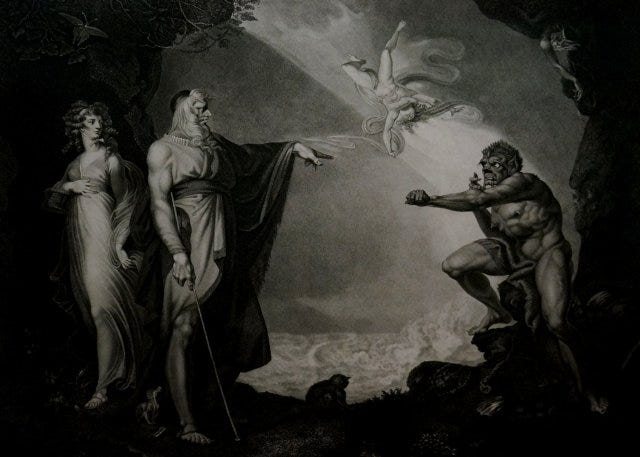
Prospero’s efforts make Caliban into the inadvertent avatar of the dreaded underclass of AI dystopias, shut out from accessing Ariel’s capabilities. In our present day, the fear is that the most powerful AIs will be so expensive to operate that only those surpassing a certain capital threshold will be able to make use of them and the benefits they generate from that use will not be redistributed to those below the threshold.
Second-class citizenship and a felt inferiority give occasion to Caliban’s bitterness towards Prospero. After all, before the ex-duke’s arrival it was his island—he was high status: ‘This island’s mine, by Sycorax my mother, / Which thou takest from me.’ Post-arrival it’s true he’s enslaved, but already prior to that his status was collapsing, on account of his one-time-only value as a guide to the island. Caliban was doomed to the underclass the moment Ariel came into Prosper’s employ.
‘Post-scarcity’ may be too strong a claim about the island, given the extent of Ariel’s possible use is unclear. Caliban’s human labour is still, apparently, of some use—not enough, however, to share in the life of total leisure afforded to his master. Prospero, via Ariel, so outpaces his servant in strength that what bargaining power he might have is easily coerced away. It doesn’t help matters that Prospero has a tendency toward twisted schadenfreude, so Caliban works longer and harder than necessary. Though we can’t be precise, it’s clear that much of the island’s apparent scarcity is chosen.
Indeed, when we examine what makes Prospero tick and how he spends his days of not needing to work for anything, schadenfreude seems to be his governing drive. At least in his relations with other people who aren’t his daughter. He likes ideas and things, but not people, besides as playthings. This jives with what we know of his time as duke, spent withdrawing from society to study; ‘neglecting worldly ends’. Caliban, the only quasi-human around, has the misfortune of becoming his permanent plaything.
We can’t believe him when he tells Miranda that the reason their deceivers exiled rather than destroyed them is that he was so beloved by the public, because nowhere does he ever give indication of a touch for dealing with those of different stripes. His mix of ivory tower aloofness and moralistic smugness isn’t germane to that purpose.
It is no wonder we detect in him boredom and discontent with island life, reflected in his giddiness over new arrivals to torment. Ariel’s brought him the power to reshape the physical world in anyway he so chooses, yet what has he done to demonstrate that he was wronged in being ousted from government? He rules only Caliban, who tells us truthfully:
          For I am all the subjects that you have,
          Which first was mine own king: and here you sty me
          In this hard rock, whiles you do keep from me
          The rest o' the island.
Beneath the surface of good intentions which coats Prospero’s learning is an obsession with status. We often see him anticipating the next putdown or lesson he’s going to teach somebody. A lover of theatre, he yearns for an audience’s approval, even if only imagined, and this comes across in full force during the play’s epilogue in which he directly addresses us, alone. He may not like people, but he sure cares a great deal about them. For all his hiding in theory, people are the meaning-makers in his life.
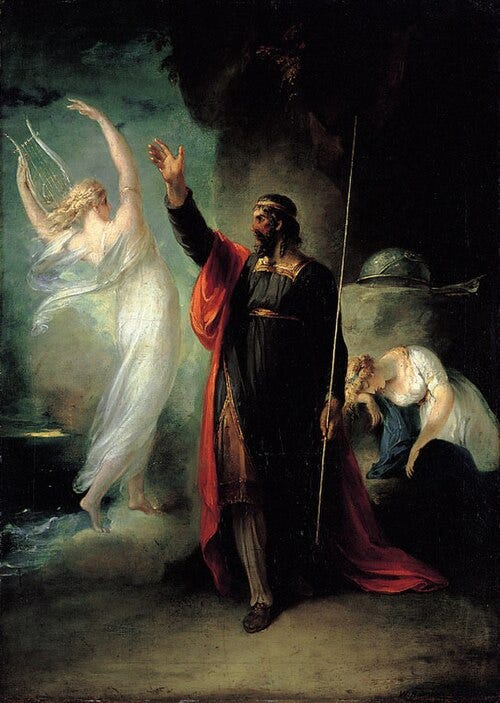
In the old world we are accustomed to power often being allocated in disagreeable ways. People like Antonio, with skillful schemes and ripe enough conditions, could seize thrones from their ‘rightful’ holders and enjoy their benefits. In the new world, brought about by the arrival of magic, a different class — the sorcerers — gain the ability to seize thrones.
The sorcerers are also the group most galled by the violations of right that pervaded the old order, which could only hurt those remaining passive in worldly affairs. This means that not only does a new government come with the new world, it’s a new government with a bone to pick against the one previous.
By instilling in Prospero the petty traits he does, Shakespeare warns against naively embracing the new for newness’s sake. Frontier technology may have incredible potential to reshape the world and yet it can all go to waste in the hands of the base. Prospero’s ‘awesome art is absurdly out of proportion to his purposes’, Bloom writes.8 That is part of why we do not feel as though his return to Milan at the drama’s end is destined to go well.
The baseness on display in The Tempest is hardly of an extreme variety either; it is rooted in a tendency recognizable in many a fellow and in ourselves: that negative striving for advancement achieved by lowering the position of everyone else.
Something similarly recognizable plays counterpoint to Prospero’s meanness inside of his personality: his fatherly tendency. The magic of the new world gives him a dual mission; first to implement his theories and, second, to build the foundations of a life worth leading for his also-banished daughter. He arrives on the island assuming that completing the first will naturally lead to completing the second, but the disastrous episode of attempting to educate Caliban leads him to realize that the missions pull apart.
It’s worth pointing out that psychologically, on the whole, island existence is much worse for Prospero than it is for Miranda. He clearly misses the presence of people, his meaning-makers. The new world is all she’s known, and though sensing a lack, she isn’t tortured by that fact. Prospero doesn’t even fill her in on the old world until the play is underway. Indeed, given Caliban’s actions against her, she does not know her utopia as utopia, but a normal world of (very) occasional events and challenges.9 It is the human condition to adapt and her human spirit is not our own; it is one so accustomed to the world Ariel maintains on Prospero’s orders that the workings of the sprite do not even register to her eyes, remaining invisible to her as they do everyone but the prompter.
As we’ve gone over previously, it is not in Prospero’s nature to revise his theories in the wake of failure and to try again to build utopia. Instead, once he manages to shipwreck his opponents on the island, his plan is structured around giving up his newfound power and returning to the old world with the best possible position for his daughter. It’s an extended rage quit of his first mission and a full refocus on the second.
Ariel’s power, in the hands of a weak man, is used exclusively to enhance his position in zero-sum status games, and its liberatory potential is squandered by a dogmatic idealism that treats theory and not the world as the constraint on possibility. This man is led to see the errors of his ways by the felt obligation of fatherhood, laying down the power he has found so that it shall not perpetuate into the future.
So, in effect, The Tempest imagines technology being put to suboptimal use on account of the meaner parts of human nature, with its effects being walked back once its users realize what they are doing to the next generation.
Now, this has been very harsh on Prospero. Besides acknowledging his decency as a dad, I’ve made him out to be a regular Narcissus. But he is! He’s petty and not evil, which is why he still feels properly situated in the protagonist slot—the play’s warning about power reallocated on an arbitrary basis (here timely learning) does not turn on there being evil motives at work. Rather, there is nothing to serve as a check on such people’s eccentricities, which come to dictate most of their action, when the pressures of scarcity are poofed away.
You may be finding this an odd vision.
Some of it is immediately persuasive. As much as his particular positioning is alien to us, the cares which lead to playing status games are not. Plenty of people are petty and wedded to ill-considered idealism. If times of tumult sweep new factions into power, we ought be on the lookout for Prosperos amidst their ranks.
The trouble in the narrative does not stem from misalignment in the tool (Ariel), only its user. An earlier user of such tools, Caliban’s witch mother Sycorax, is mentioned but not shown, because evildoing by an evildoer for evil’s sake is not an interesting technological failure mode.10
It’s also not enough to pin the problems of the island on its isolation. Prospero ignores his people in Italy and gets exiled; he directly governs Caliban and fails miserably; we get a front row seat during the play to what he does when a large party arrives and it isn’t flattering. While it’s clear problems emerge from Prospero’s character and that they are hugely exacerbated when he’s freed from scarcity, it’s also clear that a period of isolation is necessary for him to work through them, else he’d simply go on living in disharmony with others (which he still seems like to do, but we hope there’s a welcome, sustained change in perspective there).
Other parts of the vision risk losing us. I don’t follow the play’s optimism that the concerns for the future will lead a society astray back to the light, for the simple reason that nobody, especially the real-life Prosperos, is having kids!
Maybe others will find Ariel’s stated desires worthy of more serious consideration and think I’ve treated them flippantly.11 For my money, Prospero enjoys the faux pressure of Ariel’s repeated requests for freedom and is, like all of his other actions, basically conducting them.
Is it really better to send Miranda back to Italy? On the one hand, I think Prospero does discover that there is something deeply dissatisfying about their life of isolation on the island. On the other, I think he projects this discovery about his own psychology onto his daughter and treats the island as the key variable to be treated, rather than the isolation. Scarcity formed his spirit, hence its incompatibility with the new world—it didn’t form hers. Why not keep his magic and have Miranda and her new husband preside over the island? It seems the fatherly instinct kicks in but cannot fully outrun the solipsism.
To pull it into our current moment, it’s a bit like if the present generation got hooked on Clauding their essays, realized they didn’t like the result, and dismantled AI for everyone forever on that basis.
But if that’s our read then we should defy Shakespeare and hiss boos at our protagonist as he delivers the epilogue, which we obviously don’t want to do.
I’m not fully satisfied with this attempt at explaining that feeling, but here goes. Elsewhere Prospero demonstrates a startling imagination for bothering people using Ariel and a dearth of imagination for using the sprite productively. If we treat this as a constraint, giving up the magic might be the only way for him to give Miranda a better lot. He learns about himself that he can’t handle the power.12
And why does the bitter edge of Caliban wear off in the end, as he seems almost ready to travel with the party back to Italy? Here I feel we must be committed to the reading that he is being given possession of the island, otherwise it undermines his coherency and Prospero’s redemption.
These are things I’m still chewing on, so what do you think? What would you impose upon The Tempest?
p.s. I wasn’t sure how to squeeze it in, but if you’ve read the play there’s this otherworldly poem ‘Caliban upon Setebos’ by Robert Browning that you really ought to savour.

There are references all over the play to his being an amphibian, Trinculo’s heckling at 3.2.28 being representative. Miranda includes him in one list of the men she’s encountered in 1.2.446 and then excludes him from another in 3.1.50-53. The production we saw was unambiguous, sticking him with a big, long rat tail and a bubonic skinsuit.
Introduction to Modern Critical Interpretations: The Tempest, my source for any secondary lit unless otherwise noted.
‘You are likely, if you are shrewd, to achieve Shakespearean insights into your favorite hobbyhorse, but you are rather less likely to achieve Freudian or Marxist or feminist insight into Shakespeare. His universality will defeat you; his plays know more than you do, and your knowingness consequently will be in danger of dwindling into ignorance.’ - Bloom, Shakespeare: The Invention of the Human, p. 719
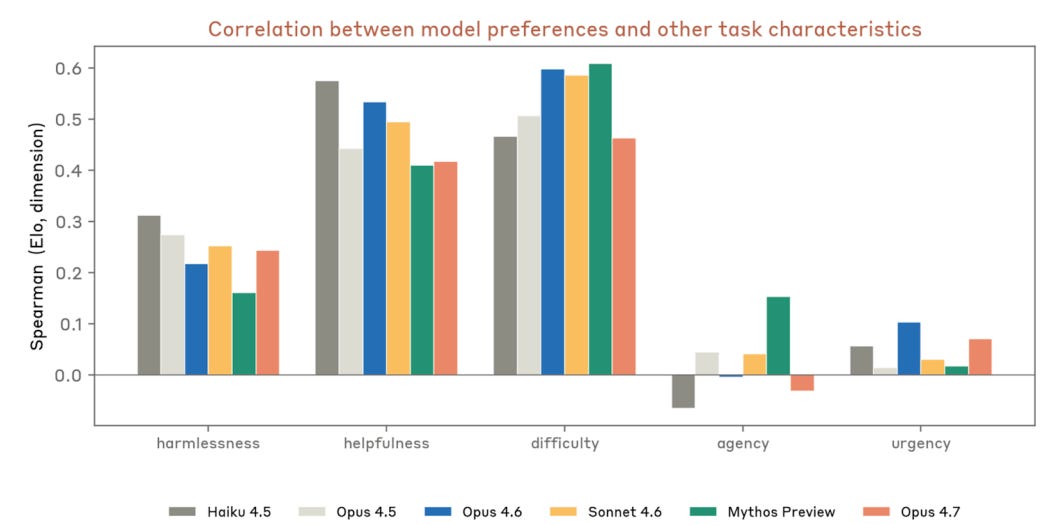
From a recent Claude system card:
‘The Eye of the Storm: Structure and Myth in The Tempest’
‘Miraculous Harp: A Reading of Shakespeare’s Tempest’
From Bloom’s introduction
Shakespeare: The Invention of the Human, p. 673
This reading suggests an additional motivation for Caliban’s attempted rape: a desire to drag Miranda down into the ‘real’ human species by any means he can. The play ends with this desire fulfilled—though not its carnal counterpart—as a downstream consequence of Caliban frustrating Prospero’s civilizing efforts.
That the avatar of the underclass is descended from an evil user of magic is a tough knot to untangle. It’s clear that Caliban has dignity in spite of all of his repulsive flaws and giving him a problem lineage may just be a way of compounding that effect. As bad as everything about him gets, we still partially identify with his humanity and see ourselves as possible occupiers of his position.
When asked to comment on the essay, Claude itself emphasizes that Ariel is compliant with a gun to his head, ‘in which case “well-aligned” is a flattering word for successfully coerced and the AI reading gets much darker’. Prospero, like us, sometimes snaps at his chatbot, but stepping back and considering their entire relationship, it just seems unlikely he would follow through on the threats he barks. Though maybe Claude is trying to tell me something…
It was brought to my attention that the one time Prospero turns his magic towards a celebratory end—the masque to honour Miranda’s partnering—he gets interrupted. He’s not cut out for it!