
I often hear people complaining about the market or a specific company in reference to some product that is in demand at the moment. People hate on the market because of:
Fast fashion, unhealthy food, AI-generated music, art, and writing, short-form content, the popularity of singles and playlists over albums, algorithmic music recommendations, cheap, convenient, mass-produced food and products over charming artisanal ones, reductions in quality for products like clothes or toasters, products that enable and nurture solitary introverted behaviour over pro-social behaviour, (video games, pornography, DoorDash, X) pornography in general, (especially including the recent episode on X) the loss of small businesses in favour of larger ones, increasing urban densification (building vertically or horizontally, both get hate), the increasing marvelization of movies and the push towards sequels and attention to profits, the rage and clickbait media landscape, the prioritzation of physical apperance in dating apps and social media, the advent of a post literate society, the proliferation of companies with online gambling as their main revenue source, nicotine flavoured with bubblegum and other related addictive substances, airline companies economizing on space and meals, cheap disposable items meant to be replaced rather than repaired, and finally, the inclusion of ads in everything.
Simple thesis: These people blame markets and companies, and not the actual cause, which is consumers earnestly demanding these products. The reason they attribute blame to markets instead of the median consumer? Social desirability bias.
Let’s take the complaints about quality of contemporary clothes, for example. Alex Tabarrok has a wonderful post on this.
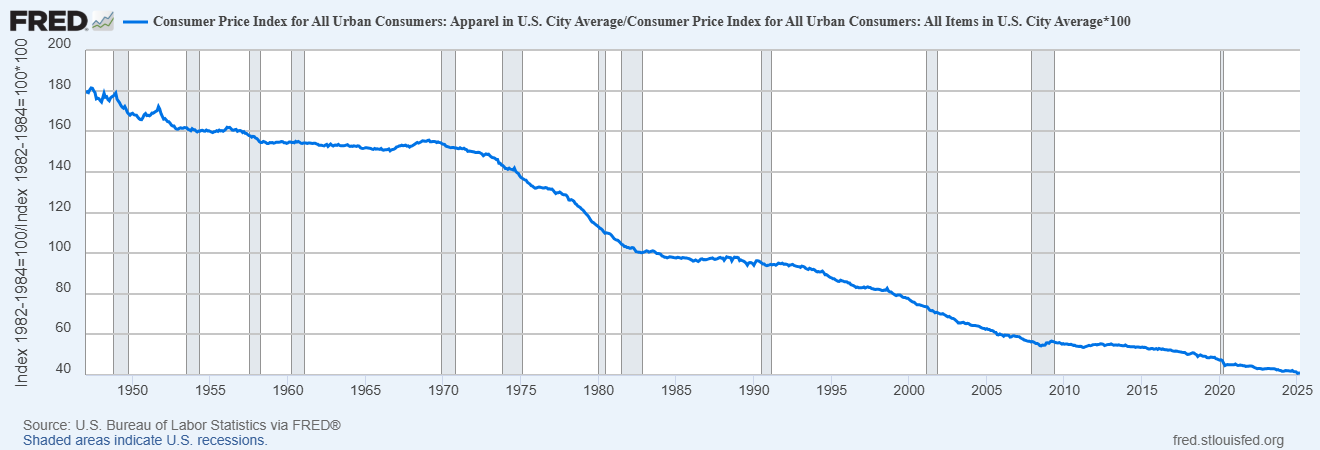
Although the average cost of clothes has decreased substantially, people often retort that the quality of clothes has also decreased. But this is all demand driven! Many consumers prefer fast fashion and cheaper clothing. The market is satisfying this preference. For those that prefer higher quality clothing, the market is also satisfying them. Alex writes:
Consider clothing where function, not just fashion, is paramount: performance sportswear and Personal Protective Equipment (PPE).
There has been a massive and obvious improvement in functional clothing. The latest GoreTex jackets, for example, are more than five times as water resistant (28 000 mm hydrostatic head) compared to the best waxed cotton technology of the past (~5 000 mm) and they are breathable (!) and lighter. Or consider PolarTec winter jackets, originally developed for the military these jackets have the incredible property of releasing heat when you are active but holding it in when you are inactive. (In the past, mountain climbers and workers in extreme environments had to strip on or off layers to prevent over-heating or freezing while exerting effort or resting.) Amazing new super shoes can actually help runners to run faster! Now that is high quality. Personal protective equipment has also increased in quality dramatically. Industrial workers and intense sports enthusiasts can now wear impact resistant gloves which use non-Newtonian polymers that stiffen on impact to reduce hand injuries.
Many products in the past were of lower quality, and more expensive (adjusted for inflation). The ones that were of higher quality and price, like jeans, were often so because they physically couldn’t make them lower quality, even though many consumers desired that. A similar story can also be told for those complaining about lower-quality appliances.
Once you accept this truism, you will start to see it all over. People attributing blame to AI companies providing access to AI-made music is of course nonsense. They are simply fulfilling the demand of consumers. An AI-generated artist just recently hit 4 million monthly listeners on Spotify. (for context, Jimi Hendrix has 6 million, and James Brown has 4 million) This doesn’t make me feel bad. Why should I be sad that people’s revealed preference is for smut over Tolstoy or singles over albums or sequels over originals? I’ve long ago accepted these facts. The reason this stirs up such negative feelings over markets is because most people have a very hard time admitting the socially undesirable truth: most people are philistines. This anti-Quaker truth is much harder to say outloud than to talk badly about Amazon or OpenAI or markets, which are easy scapegoats in a culture where Rawls reigns supreme. I bet you’re already thinking to yourself that I’m an elitist. This is part of the problem. Why is it bad to admit that the average person has terrible taste? This just seems obviously true, and people do mental gymnastics to avoid saying it out loud, and worse, end up vilifying entrepreneurs as a consequence, some of society’s finest members.
Obviously, you understand that when you get happy about the market satisfying your preferences, this is a good thing. But because you hopefully have the ability to sympathize, it is also obvious that the market satisfying other people’s preferences is a good thing!
*Provided it does not have severe negative externalities. Of course, you may have an objection to some products because of this, for example, fast fashion creates a lot of waste. But for almost all of my examples, there are no serious negative externalities. And even then, shouldn’t you be cautious about this line of thinking? You can make up an externality argument about anything you want to dislike after the fact. For example, if George R.R. Martin announced he was finally planning on publishing the Winds of Winter this year, that would have certain negative externalities on tree populations.
Yes there has been a decline in reading, yes there has been a reduction in small businesses in favour of stores like Walmart and Amazon, but this should make you happy, not sad. The market is working well. What’s the alternative? Force people to read more against their will? Force people to buy more expensive, inconvenient products simply because you have a preference for local goods? You’re a tyrant! And why not another insult: is there anything more childish than insisting that other people like what you like? You know what, I’ll even double down. It actually makes me happy that people listen to AI-generated music, because, although people in my personal life routinely deny it, I am capable of empathy. Those AI music and Baby Shark listeners are gaining so much utility, and they would probably call the music I like boring. To them I say we have reached an impasse. I then go and hang out with the people who have similar interests to me.
The beauty of America/the internet/the market is that you can go anywhere. You don’t need to live in Ohio and eat fast food all day. You can move to Northern California and just eat at farmers’ markets. You don’t need to consume pornography if you want to be on the internet. You can just hang out in r/bible or watch short-form fishing videos. Similar things can be said for AI art or algorithmic music recommendations or high and low quality clothing. Markets provide variety, and you will inevitably dislike some of it. Instead of becoming a socialist, just be tolerant. So, what’s the problem with my way of living? Why not join me?
I'd say the blame is mainly attributed to the streaming services and labels that are giving platforms to ai music. Especially when you have Spotifys algorithm pushing non-human music while simultaneously claiming "artist empowerment". I also don't believe this huge consumer demand for ai music exists. There is a label demand for ai music because it's cheaper and easier to control, and so Spotify algorithms are pushing this music for the labels. The same can be said about singles over albums. People didn't just randomly begin to prefer singles over albums, they were slowly conditioned over an extended period of time by the industry for that preference because it's cheaper and more profitable to produce singles over albums. Same reason solo artists are more popular than bands nowadays. People aren't purposely seeking out the music though, it's being fed to them. There's more than enough unoriginal and bad human made music to go around for those that like it.